Connecting Through Canvas: Teesha’s Artistic Introspection
‘There is something deeply captivating about clay, it is a material that feels alive in your hands, responding to every touch and movement.’
–Do you tend to lean more towards paintings of animals? Is there a reason for that?
Art has always been a way for me to communicate emotions too profound for words, and I find myself drawn to animals as my subjects. There’s something extraordinary about capturing their essence on canvas—their eyes, their movements, their silent language that transcends words. Though we cannot converse in the same language, animals have feelings, fears, and joys as real as ours. Yet, we often overlook their struggles. As we expand our cities and industries, deforestation continues to rob countless creatures of their habitats, leaving them displaced and alienated. These animals are no strangers to our planet; they are co-inhabitants who have as much right to thrive as we do. Their world, however, is shrinking. They face challenges born not of nature but of human neglect and exploitation. Through my art, I hope to spark a sense of empathy—a reminder that these creatures are not voiceless; they speak through their presence, their resilience, and their suffering. It is time we listened. Imagine a world where humans and animals coexist in harmony, where our actions consider not just ourselves, but all the lives intertwined with our own. It begins with small steps: preserving forests, protecting ecosystems, and fostering kindness toward all living beings. As inhabitants of this shared earth, we have a responsibility to be more compassionate and considerate. Because in helping them, we preserve the beauty and balance of our world—and, perhaps, a little of our humanity too.
–If you wanted your essence captured in an art form, what art style would you prefer and why?
If my essence were to be captured in art, it would take the form of an iridescent painting, alive with subtle details that beckon closer inspection. This shimmering canvas would reflect the fleeting, ever-changing nature of human emotions—one moment glowing with warmth, the next shimmering cool and serene.
The medium of choice? Mixed media, of course. Its boundless versatility mirrors the complexity of life itself, where textures intertwine, layers build upon each other, and the unexpected emerges as a masterpiece. Just as emotions evolve and transform, so too does this dynamic technique, allowing each stroke and element to resonate with a new depth. Through this iridescent interplay of colour, texture, and light, my essence would unfold—an ode to the beauty of life’s transience and the art of perpetual growth.
–Is there one art medium that you’ve always wanted to try?
As a tactile person, I have always been drawn to the idea of working with ceramics, especially exploring the intricate art of glazing. There is something deeply captivating about clay, it is a material that feels alive in your hands, responding to every touch and movement. Clay’s malleability opens infinite possibilities, allowing the artist to shape, mould, and create in ways that feel deeply connected to the senses. It is as if each piece carries an imprint of our sensory memory, a physical manifestation of creativity and emotion. For me, the journey into ceramics is not just about creating objects; it is about embracing the profound connection between the hands and the material, transforming raw earth into something meaningful and enduring.
–Do you think that you’re often quite successful in transferring the image in your head to the canvas when making art?
For me, success lies not in the outcome but in embracing the journey itself. My process is intuitive—a fluid exploration where creativity flows unbound by rigid expectations. There’s a certain magic in surrendering to the moment, letting instinct guide each step. It’s in these organic, unplanned movements that true artistry takes shape. The outcome, while significant, becomes a reflection of the process—a snapshot of the freedom, discovery, and emotion that unfolded along the way. Indulging in this process feels like the truest form of success—a celebration of creation as an experience rather than just a result.
–What art style do you feel most comfortable with and how did you know you wanted to stick with it?
For me, success lies not in the outcome but in embracing the journey itself. My process is intuitive, a fluid exploration where creativity flows unbound by rigid expectations. There’s a certain magic in surrendering to the moment, letting instinct guide each step. It’s in these organic, unplanned movements that true artistry takes shape. The outcome, while significant, becomes a reflection of the process, a snapshot of the freedom, discovery, and emotion that unfolded along the way. Indulging in this process feels like the truest form of success—a celebration of creation as an experience rather than just a result. The art style that I feel comfortable with would be abstract realism and adding subtle iridescent details. I finally found what I wanted to stick with through trials and errors. I learnt through my failures but essentially found my way to what felt organic to me.
–Are murals something that you enjoy working on? How does that differ from when working on projects that are smaller in size?
Painting fascinates me, whether it is a small canvas or a sprawling mural, the process remains equally captivating. Yet, the scale introduces a unique rhythm. Larger formats demand frequent pauses to step back and observe, to see how the work evolves in between several brushstrokes. Murals often transform into collaborative ventures, bringing together artists from diverse backgrounds. Working with a team outdoors on a sunny day is a stark departure from the solitude of my personal studio. It’s a shift in dynamics—an opportunity to connect with fellow collaborators on a professional level, understanding their unique approaches and styles. Each artist brings their own perspective to the table, creating a rich tapestry of ideas and techniques. The beauty lies in learning to respect and celebrate those differences. In the end, this unity in diversity fosters a harmonious outcome—a mural that reflects the collective spirit of its creators. For me, these collaborative experiences are more than just artistic endeavours; they’re a testament to the power of teamwork and the shared joy of creation. Besides, my smaller projects are intense in terms of process where I often lose track of time while painting. I have the freedom to work as much as I like which differs from a collaborative project.
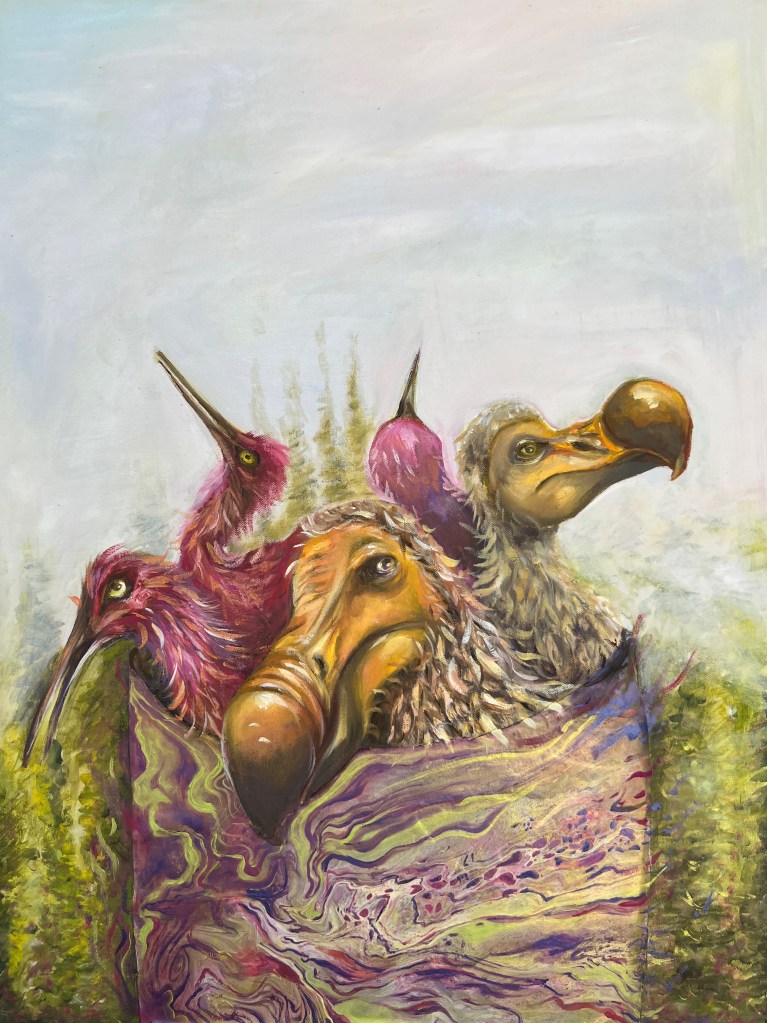

–How did it feel exhibiting your work at the National History Museum of Mahebourg?
Throughout my artistic journey, I’ve often wrestled with a lingering sense of dissatisfaction—an inner voice constantly reminding me that my work has a long way to go. This changed during my participation in Myths and Reality, an exhibition that became a turning point in both my craft and mindset. I made my mind to take a leap of faith and seize the opportunity of exhibiting my work. The experience was transformative. Surrounded by fellow artists from diverse origins, I gained invaluable advice that expanded my perspective on art and creativity. But more importantly, I began to confront and transcend my own self-doubt. I learned to let go of the unnecessary pressures I’d placed on myself and to trust the authenticity of my process. On the other hand, the thrill of exhibiting alongside global artists and my own classmates was unmatched. It was a moment of pride, not only for me but also for my parents, friends, and family who celebrated this milestone with me. This journey taught me that growth isn’t just about perfecting the work; it’s also about embracing the journey, finding confidence, and cherishing the support of those who believe in you.
–Have you ever painted yourself? Do you think you would do a good job capturing your essence?
One of my artistic ventures was a linocut print of myself, rendered in a German expressionist style and an acrylic self-portrait in cubist style. It was a fascinating process, capturing my own essence through sharp lines, fragmented shapes, and textured impressions. If it had been my personal choice, I might have chosen someone who captivates me, someone whose presence inspires curiosity and admiration. Yet, working on a self-portrait offered its own unique challenges and rewards. It pushed me to explore my identity from a creative lens, translating emotions and characteristics into abstract forms.
Even within the confines of the assignment, I found a way to infuse the work with a sense of authenticity. Whether it’s myself or someone else, the essence of the subject always becomes the heartbeat of the piece, a testament to the depth that art can reveal.
–If you could, what animal would you choose to replace the lion as the king of the jungle and why?
If I were to choose an animal to represent me, it would undoubtedly be a deer. Beyond being my spirit animal, the deer is the very soul of the forest, embodying innocence, purity, and kindness with just a single, graceful glance. What makes the deer so extraordinary is its quiet strength. Unlike the bold roar of a lion or the cunning of a predator, the deer rules the jungle in its own unique way through its ability to remain discreet, peaceful, and undisturbed. It moves gently, never disturbing the harmony of its surroundings, and always seems to inspire a sense of calm. In a world often consumed by chaos, the deer reminds us of the power of kindness as a ruling energy. We need more compassion than conflict, more harmony than dominance. The deer, with its unassuming presence, serves as a beacon of peace—a quality we should all strive to embody.
Join the Newsletter
Connect with Teesha
To follow Teesha, you can find social media profiles here:
Socials
Instagram
Read other articles in the issue
 ManicWorld Magazine