Cut and paste: Steve’s perspective
‘Surrealism seems to me a way of viewing the world from another perspective. If the overall piece is persuasive enough, it seems completely real.‘
-How did you realize that collage making was something that you were interested in?
I think I eventually realized that I’m not that good at drawing – though I would like to be. I can draw faces but things like proportions are beyond me. I tried to be a conventional artist for a long time. I did badly at school, mostly because I was severely bullied (something I’ll never get over). Then I went onto Art College to do graphic design. I failed the course, which was something I felt ashamed of for a long time – now I don’t care, in fact it’s a badge of honour that I failed. We live in a world which is pathologically obsessed with the idea of ‘success.’ It’s all a load of bullshit. It’s actually okay to fail at something – ultimately it’s a barometer of your ability. So when I was at art school, I enjoyed playing around, making short films, and splashing paint on canvas (I sometimes still paint, in an abstract expressionist style). But none of that was particularly relevant to my course. Anyway, this is a long winded answer to your question. One of my skills is doing layouts; the arranging of objects and the use of space. This lends itself to collage because the background needs to support the images in the foreground. Moving an image around until it feels like it fits. Often, even moving it 1cm in another direction can change the impact of the overall piece.
-How does the piece come together in your mind?
Is it already finished in your mind before you start it, do you get more ideas as you go along? I have a vague idea in mind when I start making something, often sparked by a visual cue. I make all my pieces the old fashioned way using scissors, paper and glue. It’s easy to create digital collages (or, God forbid, AI collages). Too easy. It’s more challenging to do it like this. The initial spark might come from some pictures in an old encyclopaedia (I have dozens of books to cut up, mostly from charity shops). The process is quite spontaneous. It’s about being playful. And there are endless permutations to be explored. I might find a picture of an old 1950’s car, and superimpose it on a background of outer space. Or maybe try a background of Niagara Falls. Often I will try half a dozen different backgrounds before deciding which works best.
Is there a theme that you have noticed in your work?
Creating collages is mostly unconscious. But I’ve churned artwork out over the past few years, and made hundreds of these things. Standing back, and viewing them as a whole, I can see certain recurring themes. One is a satire on the hateful drivel produced by advertising agencies. I think advertising is a stain on modern culture, though I can appreciate a lot of talented people have worked in advertising before moving on to better things (Jonathan Glazer being a good example). I’ve never had a solo show but I have a title in mind if it ever happens –‘STOP SELLING ME SHIT I DON’T NEED.’ That’s what advertising does basically – make people fill their lives with more crap. The omnipresence of advertising is a reflection on the emptiness of modern life. We’re all trying to fill that inner void somehow. So another part of my work is about returning to nature. There are lots of surreal images of people in nature, trying to reconnect with the earth, trying to find a more soulful and harmonious way of existence. Deep down, we all want this but have become so brainwashed by capitalism, we don’t even know this yearning is there anymore. I’m generally very pessimistic by the way, about humanity and the future of this planet, particularly since a money grubbing, climate change denier became president again. It’s deeply depressing.
-Why did you choose to make surrealistic collages?
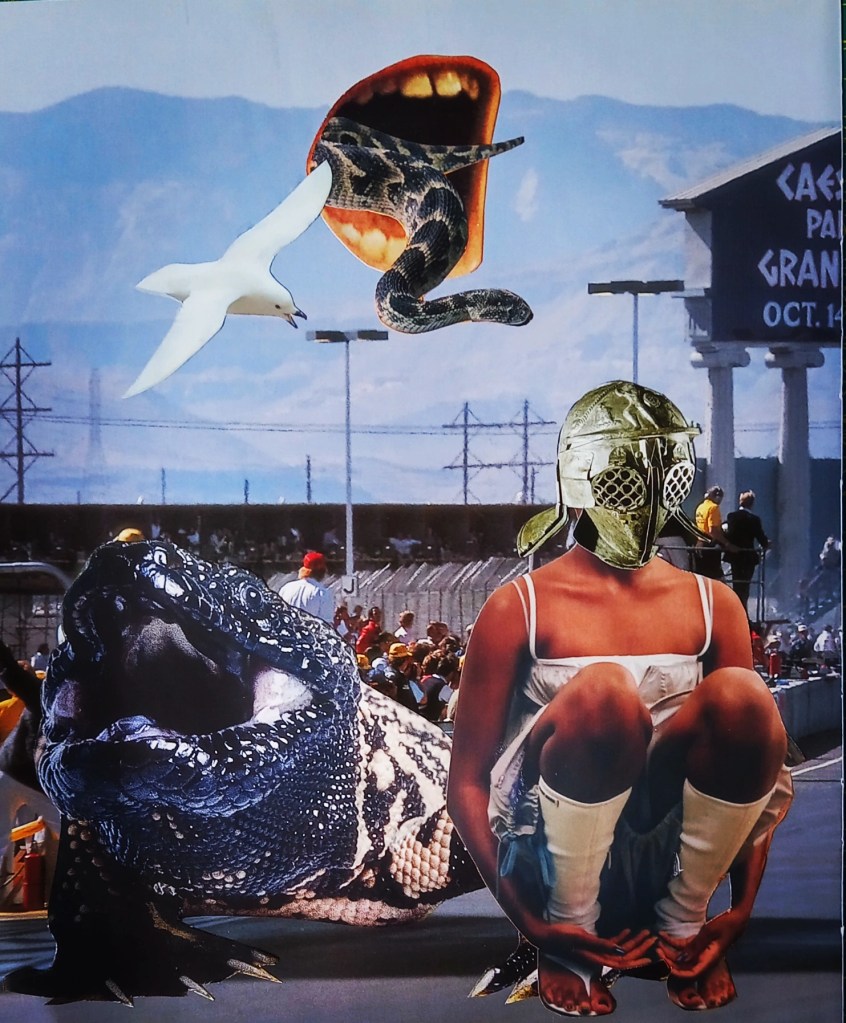
I mostly make photo collages. The trick is to make the juxtaposition as convincing as possible. When you cut an image of a person out of a book, there’s often a white edge around the cut. I quickly learned to carefully colour around the white part with a felt tip pen. The join has to be seamless. Surrealism seems to me a way of viewing the world from another perspective. If the overall piece is persuasive enough, it seems completely real. Like a collage of a skier sliding down the back of a giant snake. There’s a childlike fascination when we see something like this, like glimpsing a parallel universe. It’s hypnotic.

-How do you get ideas for your pieces?
Like I said, it’s a case of my imagination being sparked. It’s important to have a wide and eclectic selection of course material. Sometimes I might buy a book from a charity shop and there are dozens of images which I can use (Dorling Kindersley publications are particularly excellent because they’re mostly visual). On other occasions, I might only find a few images in a book. It seems harsh, but for space purposes, I have to throw old books away. I wish I had a studio where I could store more material but sadly I don’t.
-Take us through your production process.
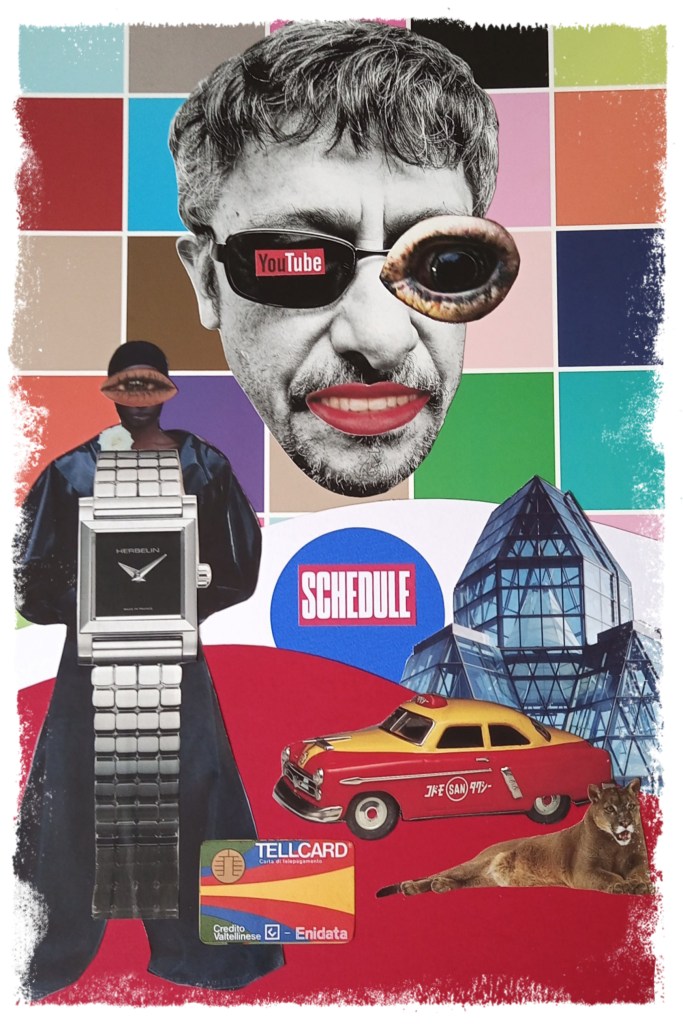
I’ve probably already answered this, though I often put the process on pause for a while before finishing. I will have a collection of images I want to use and play around with them on the background. Recently I’ve started doing more minimal work, on a plain white or coloured background. I’m very influenced by graphic designer Peter Saville, and the sleeves he made for Factory Records. Often he would just have a plain sleeve with a piece of text, produced in a classical font. He’s probably some sort of genius I think. Anyway, this comes back to what I said about the art of the layout. I will play with images, moving them around the background until everything gels. It’s important to do this before gluing things into place because that’s final.


-When you first started, where did you think it would end?
I first started making collages in the late 80’s. A poster company was interested in my work but as is the way with these things, nothing happened. After that, I stopped making art and became more interested in theatre. I studied theatre at university, and used to do a lot of acting. Some of my plays have been produced (one was on BBC Radio 4 years ago). I worked as a theatre critic for a magazine for a long time. Weirdly, now I’ve gone back to making art. I doubt I will write anymore plays because I’ve written lots which have never been produced. At least with art, it’s easier to get your work known. I have sold a few pieces recently. I never feel I’m good enough but I know my artwork is good enough. If I have an ambition, it would be to have an exhibition somewhere but we’ll see what develops.

-What message do you hope to share through your work, if any.
I have created a few pieces which are of a more personal nature, though they’re in the minority. These are artworks that address what it’s like to live as a traumatized man in a world which is cold and indifferent. Traumatized people are always expected to turn their tragedy – and it is a tragedy – into a series of sugar coated bullet points. We’re expected to minimize what we’ve gone through to make it easier on society. This is something that makes me angry. So in future, maybe I’ll create art around this theme, it doesn’t have to be collage, and maybe I’ll go back to an abstract expressionist style.
-What are your thoughts about Schroedinger’s Cat?
I don’t think I have any really. I’m aware this is a famous thought experiment but it feels like some sort of middle class indulgence that gets discussed at pretentious dinner parties. Besides, I love cats too much; I hate the idea of one being locked in a box.
Join the Newsletter
Connect with Steve
To follow Steve, you can find social media profiles here:
Socials
Instagram
Read other articles in the issue
- A Pursuit of Calm with Timothy McGaw
- Charlie J: The Art of Nightly Verses and Cosmic Dreams
- Connecting Through Canvas: Teesha’s Artistic Introspection
- Cutting Through Moments: My Journey as an Artist
- Frames of Life: The Art of Photography
- Looking through the lens of adventure with Gazzy
- Mitchel X: The Journey of a Musical Soul
 ManicWorld Magazine