Ró-di-na (Motherland) Anti-manifesto
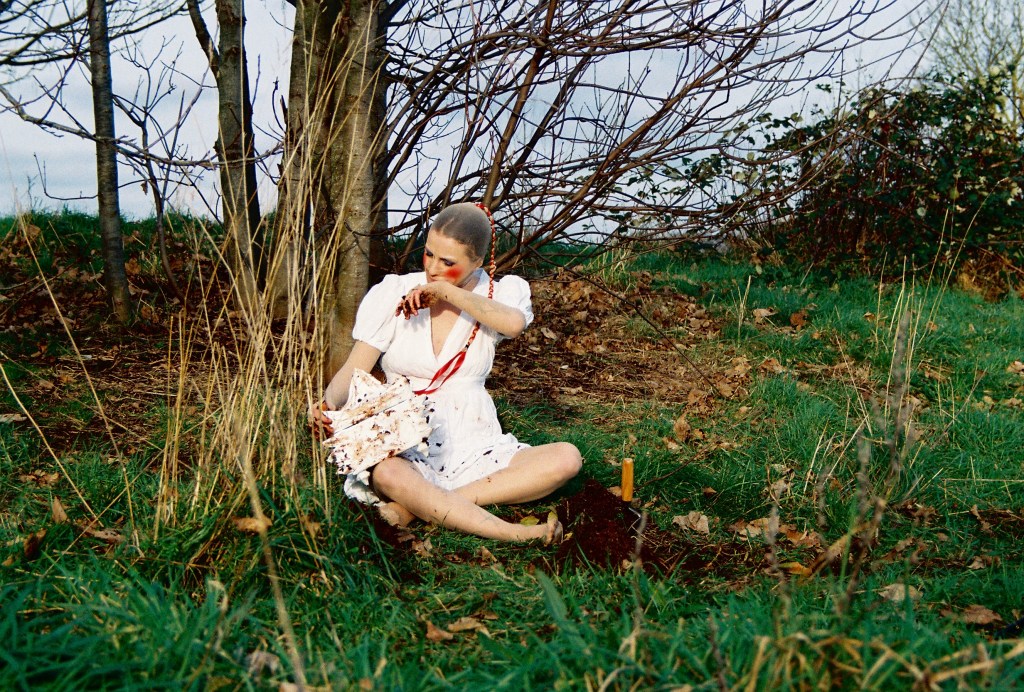
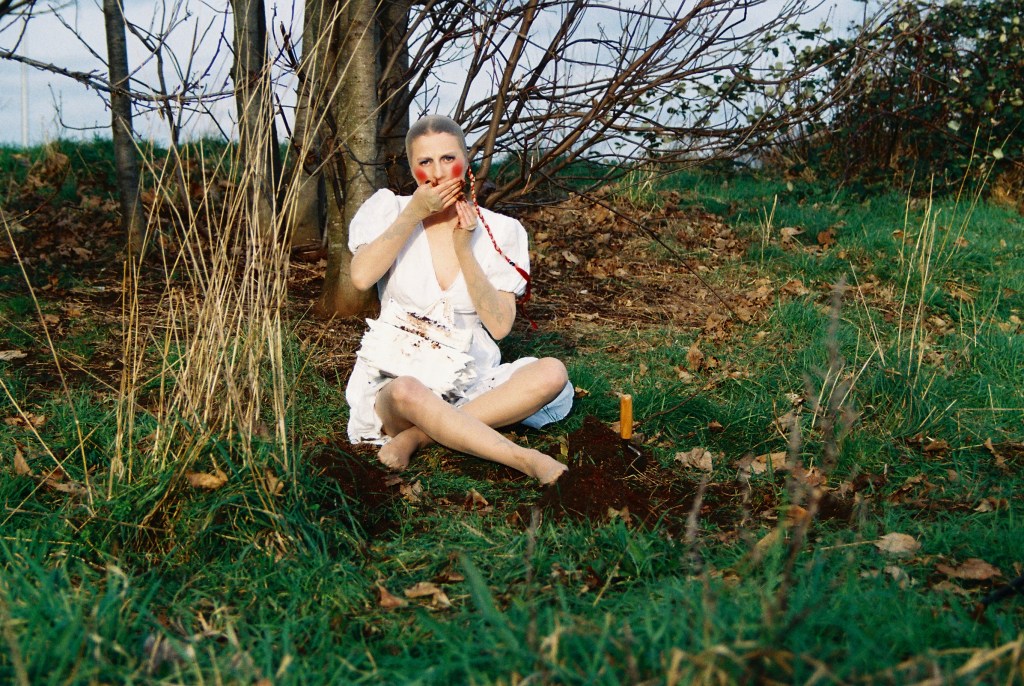
‘Dressed in a deconstructed embodiment of the Slavic motherland—a fragmented interpretation of traditional “womanly” attire—I became a vessel. The performance began with an act of raw confrontation: consuming soil, a symbol of land, history and atrocities that come with it.‘
– What inspired the creation of “Ró-di-na (Motherland)”?
The idea came from the constant and continuous consumption of the ideology that is the Motherland. Once you are made aware of the ideology and how it works within critical and emotional terms it loses all efficacy and it creates a physical detachment from the Motherland. The yearning for the return goes above all logic. The concept of ‘Ródina’ is something regurgitated for decades, as the government weaponizes people’s nostalgia and collective memory, manipulating the people into sacrificing their life for the soil.
– Could you explain the symbolism behind consuming soil during the performance?
At its core, it’s about embodying the Motherland, physically taking the essence of the earth into the body as a way to represent the connection to the country that the state has enforced through means of propaganda in schools, media and generational discourses. It directly references people’s blind devotion to a technically authoritarian regime. The soil also symbolizes blood-shed Russia incited on land stolen from other sovereign nations, like Georgia and Ukraine and how in all of these wars hundred of thousands people die on both sides. Unfortunately a large number of people in Russia have become partially immune to the losses of their loved ones in these unnecessary conflicts. I personally see a huge connection between Russian individuals who devote themselves, and those who do not, to the concept of ‘Ródina’ and their brutal indifference or even support for the loss of lives on those lands.
– What emotions were you aiming to evoke in the audience through this raw act of confrontation?
For me the confrontation in my work can be self-interpreted in many ways, all of which I find important. I wanted to stir a sense of grief; grief for the land, the people and our heritage and for the ways we as a collective society exploited both. As Anatoly Khazanov wrote in 2008 about “(Re)constructing Collective Memory in Contemporary Russia.’; “The notion of collective guilt and collective responsibility is absolutely alien to them [Russian people]”. Thus I think it is important to ignite the feelings of grief, guilt and responsibility as for the longest time Russia has remained a criminal state. But I think there is an importance in inciting a sense of reflection for Russian people and outsider perspectives to potentially arise a more comprehensive understanding of what has been happening within Russia.
How did the audience react to the performance, and did their reactions align with your expectations?
No specific audience was invited to the performance, as I wanted a natural flow of people to encounter and interact with it. This was all happening in a populated park in London, I feel as though the exact location does not serve purpose for the meaning of this piece, it has all the elements necessary for people to associate it with the Motherland; trees, soil and vast space. In front of the performance was a path. I found a lot of people would quickly turn their heads towards the performance and then continue walking as they were, only a few, mostly dog walkers, pondered in front of the performance. These reactions though deemed “not interactive”, for me portray the exact message of this piece, since a lot of people in Russia and in the West, choose not to get involved, allowing for the action to continue.
-In what ways does the Anti-Manifesto challenge conventional narratives about nationalism and cultural identity?
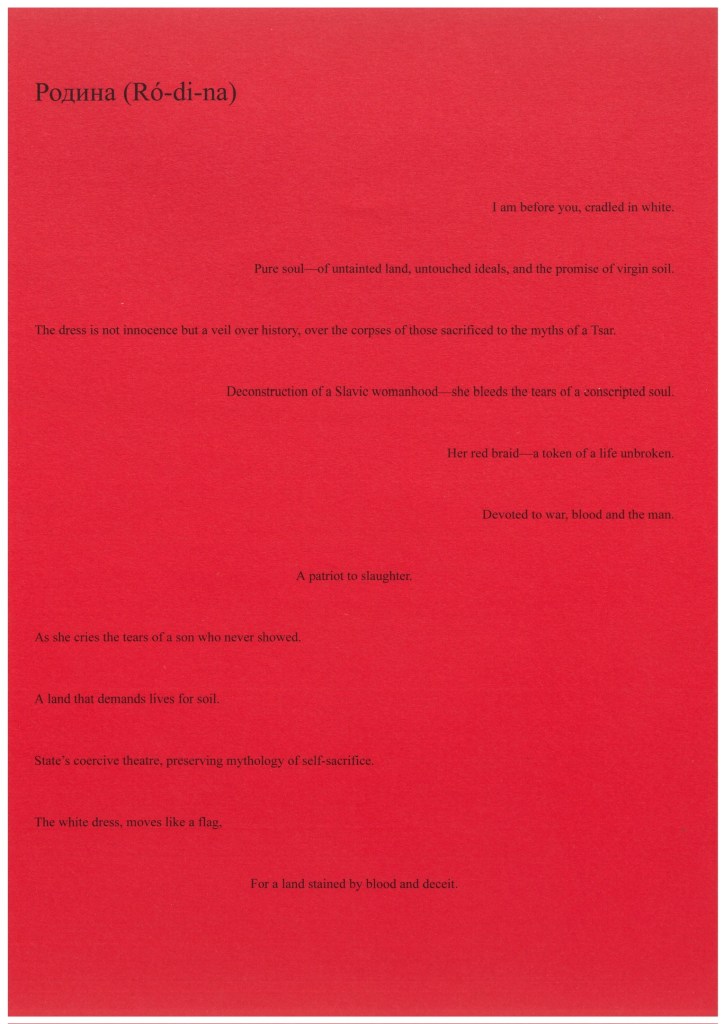
The Anti-Manifesto is fundamentally about questioning the rigid, monolithic ideas that are imposed by the government onto the people. It allows for the symbolism and metaphors within the performance to be not only present but also balanced on a page. My choice of words was very specific in order to bring in elements associated with the Motherland into one cohesive piece, whilst at the same time highlighting the irony of it all.
How has your personal history and cultural background influenced the creation of the Anti-Manifesto?
I come from a perspective of what I believe to be a true patriot, I believe patriotism is not the devotion to the government or state, but rather a set of personal beliefs and feelings which is delicately interconnected with the Motherland. I love my country very much and I am distraught by the fact I cannot simply go back there. The love I have for my Ródina does come from my loyalty to the state but from the memories I hold so dear, and the people I know, love and admire. I think a real patriot is someone who loves and protects the country. Sometimes that love requires us to go against the people in power, in order to preserve what is truly sacred. Coming back to my Anti-Manifesto, I often use very beautiful cultural traditions to reflect upon something so horrid.
– What future directions do you see for this project, and how do you plan to expand on its themes?
At the end of the day, many of my projects are in conversation with each other, I often work on multiple projects at once and there is a sort of balance of having projects breathe simultaneously. With ‘Ródina’ specifically, I see it being made into an installation from the remnants and as of now i do not think it is necessary to repeat the performance itself.
–How has Ró-di-na set the tone for your future projects?
Through embodying the Motherland, ‘Ródina’ has allowed me to also reflect on my own connections to my culture, but not in a way which impedes my criticality. In the last few months I have been working on themes of nostalgia, specifically how the use of collective memory among my nation is used to make people loyal and subservient. I feel that this directly feeds into the realm of nostalgia and I see vast potential in combining both concepts to reflect on my cultural identity from a more analytical perspective.
Join the Newsletter
Connect with Anna
To follow Anna, you can find social media profiles and websites here:
Socials
Instagram
Website
Anna Leyko
Read other articles in the issue
- Art as a Spectator: Zuzanna’s Bold Colours and Dark Themes
- Creativity and Inspirations: Thomas’ emergence
- Dtlyyyy’s on the Unpredictable Path of Creativity
- Hands That Speak: Conversations with Tyler Jackson
- Reckless Abandon: Saloni embraces creativity
- Synths in the Shadows: Maximilian’s performance
- Visual Stories and Random moments
 ManicWorld Magazine