The Conversation Photo: Capturing Stories in a Frame
”What I appreciate most about photography is how it’s made me savour moments. No matter where I am, what I’m doing, I always find myself seeing a picture.‘
– How often do you find yourself traveling for work?
I wouldn’t say I travel too often, but I primarily visit Chicago to take photos. It’s about a 20-minute drive from where I live. However, Chicago is no small city. Throughout its many neighbourhoods, you’ll find a huge variety of interesting-looking people and events that connect other creatives like me. Much of my travel photography is done when I go on a spur-of-the-moment trip. As I always have a camera with me, I’m able to capture the spontaneous moments I love so much.
-What parts of photography are you the most appreciative of?
What I appreciate most about photography is how it has made me savour moments. No matter where I am or what I’m doing, I always find myself seeing a picture. I’ll see something and pray I have my camera ready, and if I’m with my girlfriend, I always say, “Now that would have been a great picture,” then go into a long, detailed rant on how the framing of the scene was cinematic or how the colours of the person’s outfit pop and contrast against some dark background.
– Why did you start taking pictures for more than just your camera roll?
Because I’m looking for a photo that starts a conversation. I once went to the art museum in downtown Chicago, where on the lower level, they have the photography section. There was an exhibit on a photographer who took pictures of factory workers in South Africa, and one of the photos has always stuck with me. It’s of a worker in the control room in his uniform, but what was so significant about this photo is the way he posed so well for it that made me think about him for the rest of my visit.
I thought about how out of place it looked that someone in that profession could be so photogenic. I wondered what his dreams were. I wondered what if his life had gone a different direction. These are questions I’ll never get the answer to, but after that day, I said I need to find my conversation photo.
– Do you ever wish to control the way your photos are perceived?
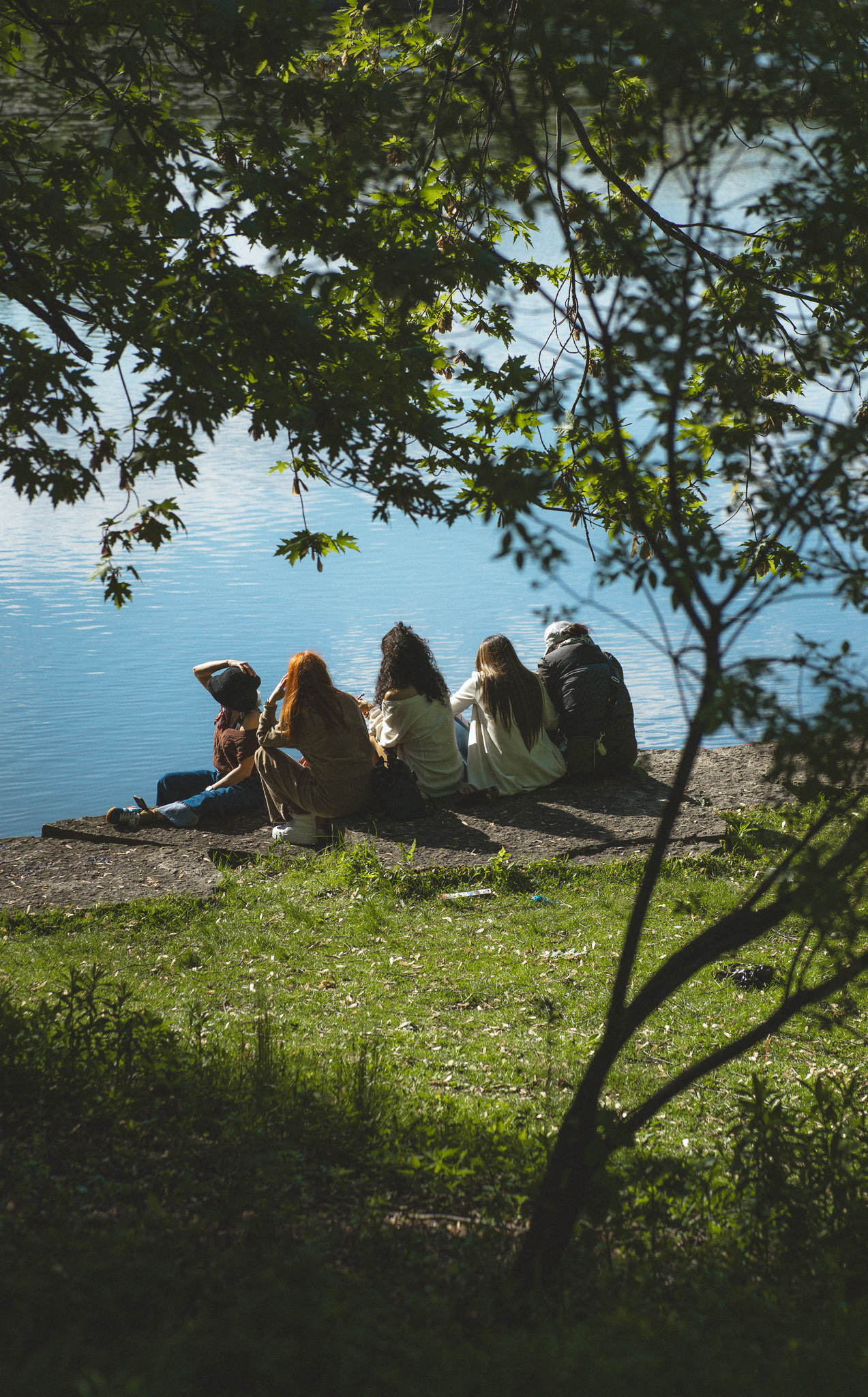
No, I think keeping things open for discussion is the best thing for my photos and art in general. I love the idea that some people might see a photo of mine and have completely different understandings. I’m not the biggest fan of forcing people to see things exactly as I want them. I may have an idea of what my photo means, and if people want to say something different, I’m okay with that.
– Do you think the way people perceive the photography industry has changed over time?
I would say it has changed a little bit. I think early on, the photography industry was seen as a specialty profession, only select people actually owned cameras back in the day. I think early on, photography was seen as a means to be used either for documentation or photojournalism.
Fast-forward to now, it’s become a booming industry. It’s taken on titles like content creator or travel photographer. People have cameras on their phones and can capture something after answering a phone call. So yes, I would say it has changed quite a bit actually.
– Describe your dream photoshoot setup?
I’d say a dream photoshoot setup would first start with a prime location, like Patagonia. Me, my camera, along with all the nature and animals that place has to offer. And give me a couple of weeks to just live. As Henry David Thoreau said, “Every morning was a cheerful invitation to make my life of equal simplicity, and I may say innocence, with nature herself.”


– Do you feel like photography is a form of escapism for most? Is this true for you as well?
I think it can be, while I don’t feel that’s what I’m always trying to do. Sometimes photos are meant to do the exact opposite. Sometimes photos are meant to be seen as living in the moment. However, I’ve had my days where I felt my photography was the only good thing I had going for me, so in that sense, it felt like an escape from my current situation. I’m sure the answer changes based on who you ask.
– What is your ‘coming of age’ story?
I think the biggest moment that changed my life was during a period where I was struggling to find who I wanted to be. I was working a full-time dead-end job, going to school to pursue a degree in a field that I felt was safe, and taking care of my terminally ill grandfather. I would sometimes have to wake up at 4:30 in the morning to take him to his treatments that could last all morning. Do my schoolwork either at the hospital or in my car in the parking lot, wait for him to get out to take him home, and maybe eat before I had to go in for my 1:30 to 10:00 shift. This went on for almost a year.
Towards the end, we traveled to Mexico so he could be with some of his family. In the final week, I probably slept a couple of hours a night. I hardly ate. I probably lost close to 25 pounds, and on the final night I had with him, I needed to find some closure. So I went into the room he was staying in, which was a couple of steps away from where I was sleeping on the floor, and I asked if he knew that I loved him. In a very faint and weak voice, he told me that he did. I gave him a hug, and that was all the closure I needed. The next morning, he passed, and we started making arrangements.
While this all sounds very upsetting, something surprising happened. Everyone in our family collectively made the decision to stay an extra week. We all called off work and emailed our professors letting them know we wouldn’t be coming to class. We said that he wouldn’t want us just sitting around crying. He would want us, while we’re together, to be enjoying the time we have.
So, at no point for the next week was there ever less than ten of us at a time. We rented two vans to drive us around and travel to different cities. We would go out together to eat, and we would stay up till almost 2 a.m. dancing, laughing, telling stories, crying, reminiscing. It was a beautiful time. We said it was a celebration of life, and after realizing what I had gone through over the past year, for it to end like that felt right. I learned so much about myself and who I was as a person. I learned what to value in life. I learned the lengths that someone who really loves someone else will go through to show that love.
– Do you have any regrets concerning photography?
No, absolutely not.
– Your portfolio is mostly candid, why is that so?
I prefer honest moments. There’s nothing wrong with posed or controlled photos. I suppose I just look for more than what people are told to give.
-Last but not least, do you think the glass is half full, half empty, or just twice as big as needed?
Half empty. Why? Because I’ve never seen a glass on the table with something in it and said, “It’s half full.”
Join the Newsletter
Connect with Sebastian
To follow Sebastian, you can find social media profiles here:
Read other articles in the issue
- Art as a Diary: Expressing the Unspoken Through Colours
- Beyond Beauty: Art, Resistance, and the Imagination
- From Scribbles to Syndication: The Making of a Comic Strip
- Listening to Stone: Dan Peragine on Art, Education, and Inspiration
- Lost in Words: The Journey from Fan-fiction to Original Fiction
- Painting the Unseen: Monsters, Mental Health, and the Power of Art
- The Phantom and the Frame: Poetry in Pictures
 ManicWorld Magazine