When Movement Speaks Louder Than Words
‘I’ve always felt more at home in spaces where logic steps aside for feeling, where the process is as alive as the final piece.‘
– What is Organic Abstract Expressionism?
To me, Organic Abstract Expressionism is the emotional pulse of abstraction, rooted in fluid shapes, layered textures, and intuitive mark-making that mimic natural forms. It’s movement without rigidity, a kind of visual breathing. My work often blends flowing lines with raw texture, like nature whispering stories through paint. It’s both expressive and elemental, less about control and more about emotional resonance.
– Why have you chosen to work with this art style?
Because it chose me, honestly. I didn’t set out to paint this way, it emerged naturally, in the aftermath of grief, during moments when words failed but movement and colour could speak. I’ve always felt more at home in spaces where logic steps aside for feeling, where the process is as alive as the final piece. This style gives me the freedom to explore softness and strength in the same breath. It’s healing.
– Why’d you make the switch from poetry and spoken-word performance to fully making art now?
I still carry a poet’s heart, I just shifted mediums. Art has always been how I process the world. In the beginning, it was charcoal drawings: figures and faces. Then I fell in love with clay and poured myself into ceramics, again, always figures, faces, masks. It’s funny, really, no matter the medium, whether it was spoken word, drawing, sculpture, or now painting and mixed media, my work has always been deeply personal. It’s my way of communicating what can’t be said plainly. A way to reach into the gut or the heart and pull something honest out. After a painful bout of tendonitis, I had to step back from ceramics and rethink how I could continue to create. That’s when I turned to painting, installation, and mixed media, forms that allow more movement, more flexibility. It wasn’t just a shift in medium, it was a shift in how I survived.

– Tell us about the Fabric Storm installation for the Oconee Cultural Arts Foundation.
Fabric Storm was the first major work I made after leaving school. It became a catalyst for my first solo show the following year. The installation was made of 48 umbrellas, over 100 yards of fabric, ribbon, fishing string, and hundreds of glass beads, suspended like raindrops caught midair.
The space was semi-immersive, with recorded sounds of thunder and rain playing softly in the background. It symbolised the storms we face in life, and how they can feel overwhelming and relentless. But even in that chaos, there’s beauty in surrender. Fabric Storm was how I processed transition, uncertainty, and growth, and it reminded me that even the hardest seasons can give birth to something breathtaking.



– Do you still make sculptures?
I do! Sculpture has always been important to me. In ceramics, I created quite a few figurative works and masks. But since access to a kiln is limited now, I’ve shifted toward mixed media sculpture, using fabric, cardboard, paper, and sometimes epoxy. It’s still physical, still layered, still expressive, just different. I’ve done more than dabble, but I haven’t made it the centre of my practice yet. That said, I’m planning to return to sculpture more intentionally, especially once I have better access to firing equipment again.
– ‘Each piece is a reflection of surrender—of what’s been survived, felt, and transformed.’ What do you mean by this?
I mean that nothing I make comes from a place of polish. My art is messy, emotional, and honest. It’s what happens after the breakdown, when you’re too tired to perform but still need to feel. When I say surrender, I’m talking about letting go of the need to control the outcome. Each work holds a moment, sometimes pain, sometimes peace, but always the truth of what I’ve lived through and what I’ve let shape me.
– Your recent work features a lot of swirls and paisley-like shapes. Is there a reason for this?
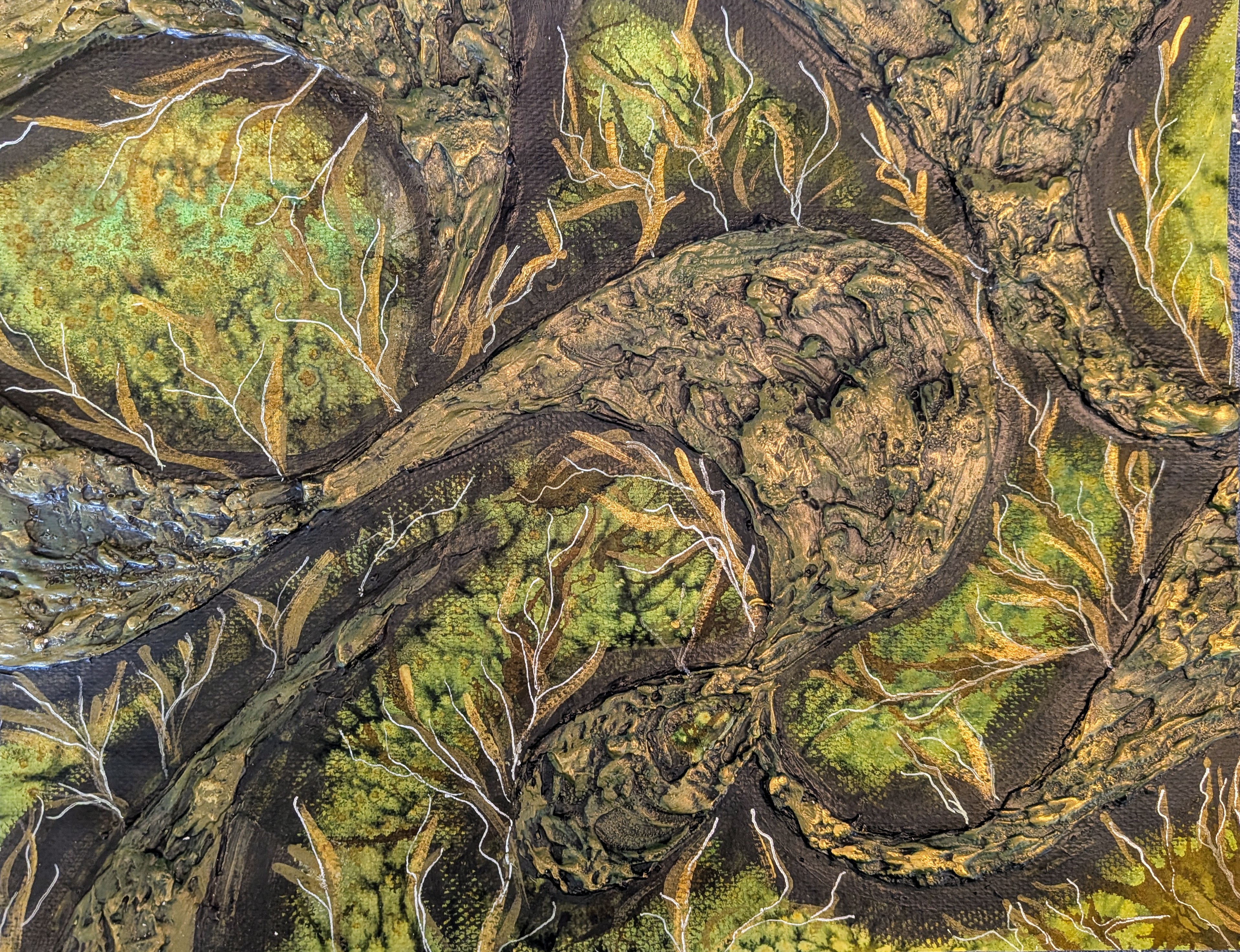
That comparison actually made me laugh, because when I created Where the Battle Broke Open, I wasn’t thinking of paisley at all. I was thinking of lightning. I made it after getting news that my car needed a new engine, something completely out of reach financially at the time. I felt the weight of everything crashing down and turned to prayer, and from that heaviness came this work. It wasn’t planned, just grief, texture, and movement pouring out. The lines remind me of roots, or veins, or prayers pushing through dry earth. Messy, layered, a little wild, but it helped me breathe again. Sometimes what looks like a crack or a tear in your life is actually an opening. A holy space. That’s what this painting became for me.
– What do you want your art to say? As plainly and honestly as you can convey it.
You’re not alone. You’re allowed to feel all of it. Beauty can come from pain. Healing doesn’t have to look tidy. God is near, even in the unraveling. And even when it looks like everything has fallen apart, you’re still worthy of love, softness, and joy.
– Last but not least, if your creativity could only come from either your heart or your brain, where would you choose and why?
My heart, always. The brain is useful, but the heart is where truth lives. It’s where the broken and beautiful meet. My creativity is rooted in feeling, in spirit, in connection. I want my work to touch something deeper than logic, to stir, to comfort, to move someone. That only happens when I let the heart lead.
Join the Newsletter
Connect with Bobbi
To follow Bobbi, you can find social media profiles here:
Read other articles in the issue
 ManicWorld Magazine