Not About Me: Art, Aspiration, and the Irony of Representation with Katie
‘I want my work just to present the information, not to give a prescription of opinion. I really value my audience, and I don’t want to insult their intelligence…’
– Where did your passion for intermedialist art?
As a school child I didn’t know there was intermedialist art, I only really knew about paintings and didn’t really understand them either. When I started at Edinburgh College of Art, I still didn’t know. In my first year I gravitated towards a tutor from Greenock, Stephen Hunter (across the water from my bit in Dumbarton and the Vale). He was one of two or three people I’d found who sounded like me and were working class, the ECA was largely full of privately educated English people and I immediately started telling tutors there had been a mistake and I shouldn’t have been let in. Stephen assured me he was on the admissions team and had seen my work and had picked me (whether this was true or not I don’t know but it worked and I stayed), I’d heard you could transfer to GSA (Glasgow school of art) from ECA and toyed with that for the next year or so. I missed home, I missed my pals and I missed being around normal people who didn’t know what an aga was. At the time Stephen was head (?),(I think), of Intermedia, one of the disciplines you could choose to specialise in in undergrad (the others were painting, photography and sculpture in my Fine Art course.)
Although I was a painter and printmaker in college (in both City of Glasgow College and Reid Kerr), the rich people gravitated towards painting and I wanted to be as far away from them as possible. I’d been asked things like had I done jail time, did I know my dad, could I get them gear, did I grow up with electricity etc, – a lot of them hadn’t met someone who wasn’t privately educated before and definitely hadn’t had a full conversation with anyone from a council estate, let alone consider them a peer. Stephen taught Intermedia and there was a lack of rich people in the Intermedia course so that’s the one I chose. Id spoken to Stephen about wanting to continue painting but not wanting to be around painters and he assured me that I could still do that in an Intermedia degree if I wanted to.
My attitude to art school was to get in, get what I needed and get out. I worked full time in a night club from my first year until just before Covid shut everything down in my fourth year. Intermedia gave me a good amount of flexibility to pack my work full of theory, meaning it wouldn’t have to be too physical and if I had to work instead of being in the studio I still had an avenue to make the work while paying rent etc. Generally I worked in the club from 6pm-4am five or six days a week, then had Uni 9am-5pm at least 5 days a week, so most of my work became very theory based and conceptual but Intermedia made room for that and was totally affordable within that context.
The very thick theory has stayed with me in my work, I like very dense theory that nearly just cancels itself out but not quite. This is helpful because I do have other commitments and other stuff to do, and means when I’m in the shower or doing the washing I can be percolating on some theory, so by the time I get into the studio the idea is feels very tough and thick and the painting (or whatever I’m doing) comes very naturally because its ready to burst out. I like that because then it feels like the only natural and logical expression of this theory soup is the thing I’m making. Sometimes I look back after years and can see how I could have added or taken things away etc. but that comes with time.
– What do you mean when you say ‘dense theory that nearly cancels itself out’?
I think I mean I like to make the work almost indecipherable sometimes, I really don’t appreciate when work is spoon fed to me so I try to steer clear of making very literal or obvious work, I kind of like it when people don’t know what going on for sure. I like to kind of play with audience that way and low key make them maybe not like me so much, I think I’m worried that if they agree with me it might be just because I’ve tricked then into liking me through the work, I want to present all the information in a big lump all mashed up together, and let them take it from there.
I think being very literal is a tool that can be used, and used well, I just like my work to be a bit more chewey. I like people to walk away not feeling like I’ve told them what to think; I often think people go to galleries etc to get the answer, I think good work will often leave you with more questions as wanky as that sounds. I want my work just to present the information, not to give a prescription of opinion. I really value my audience, and I don’t want to insult their intelligence, I also don’t want to take loads of their time and I know when I’m in a gallery I definitely feel a pressure to stay with the work for a long time which isn’t always doable for me, so if there’s a way for me to have the work stay with people for longer without needing someone to commit the visual work to memory that’s the route I take.
In terms of the theory, fundamentally in this work I’m predominantly engaging with object oriented ontology (OOO) and (predominantly) Catholic theology, they almost cancel each other out because OOO is very anthropocentric and therefore very much centres the immediate human experience, and catholic theory very much centres the non-human experience (i.e. Jesus etc), the link could be something like Timothy Morton’s Hyper-object theorem but even that is a bit of a stretch. (The other joining thread could be the kind of pride and proximity to respective power that comes in both schools of thought, philosophical academia is full of – no offence – quite boastful and prideful people, all trying to be next in line to whatever genius they venerate; and if u go into any catholic church in the west coast of Scotland you will find a good few “it could have been me” old guys who started training to be a priest before giving it up for whatever reason, and hang around the priest in residence to try and get some of the magic to rub off on them.)
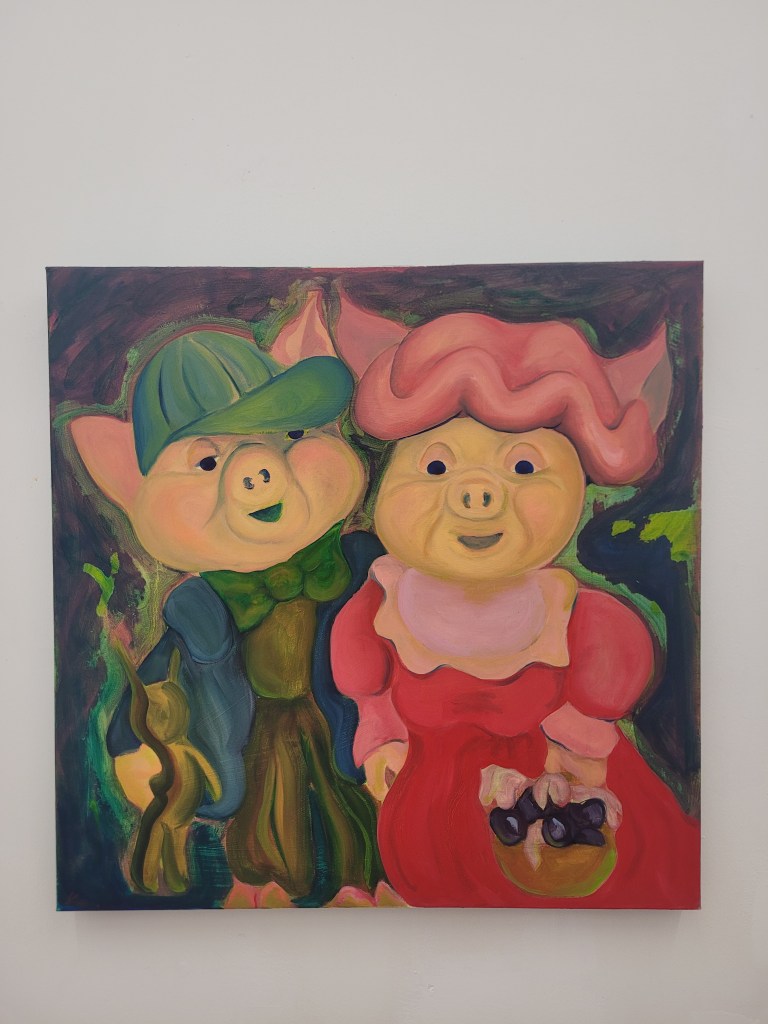
I suppose what I mean is that these two schools of thought aren’t together a lot and they do almost cancel each other out. Even in the ontologies themselves, object theory is more of an exploration and kind of open discussion of how our physical environments and the objects around us inform our lives and how we relate to them, I personally find the theology stuff to be a bit more prescriptive in how it tells us what is good and what is bad, what is wanted and what is sacred etc. even then, I’ve placed placed the pigs in purgatory which doesn’t necessarily exist in Catholic doctrine (depending on who you ask and when you ask them,) even if I’ve made it clear they are in sulphuric flames, whether they are catholic or protestant flames is unknown and potentially irrelevant despite being central to the piece.
I’m also engaging with a lot of feminist theory while the visual work is almost openly misogynist, in the piece with the two pigs, I kind of made a point of putting a lot more of the “blame” if you like on Pig, and a lot less on Boy Pig. Boy Pig, I allowed to look gormless, while Pig knows what she’s done she knows who she threw under the bus to have proximity to power and stands by it, she doesn’t try to hid her basket of other pig’s trotters. Boy Pig has socially inherited all the power and has made no moves to redistribute or challenge the power he has been given just for being a Boy Pig, the unchallenged power he has is the root of the problem but here I am letting him off the hook. I’ve also purposely made them pigs (although they are based off an ornament of two pigs I found in a charity shop) to draw the parallel to the colloquial idiom of pigs = police, and here I am policing Pig’s choices instead of engaging with them in a loving or understanding way. Again though, I don’t want people to think I want them to love or hate Pig or Boy Pig, I’m just presenting the information.
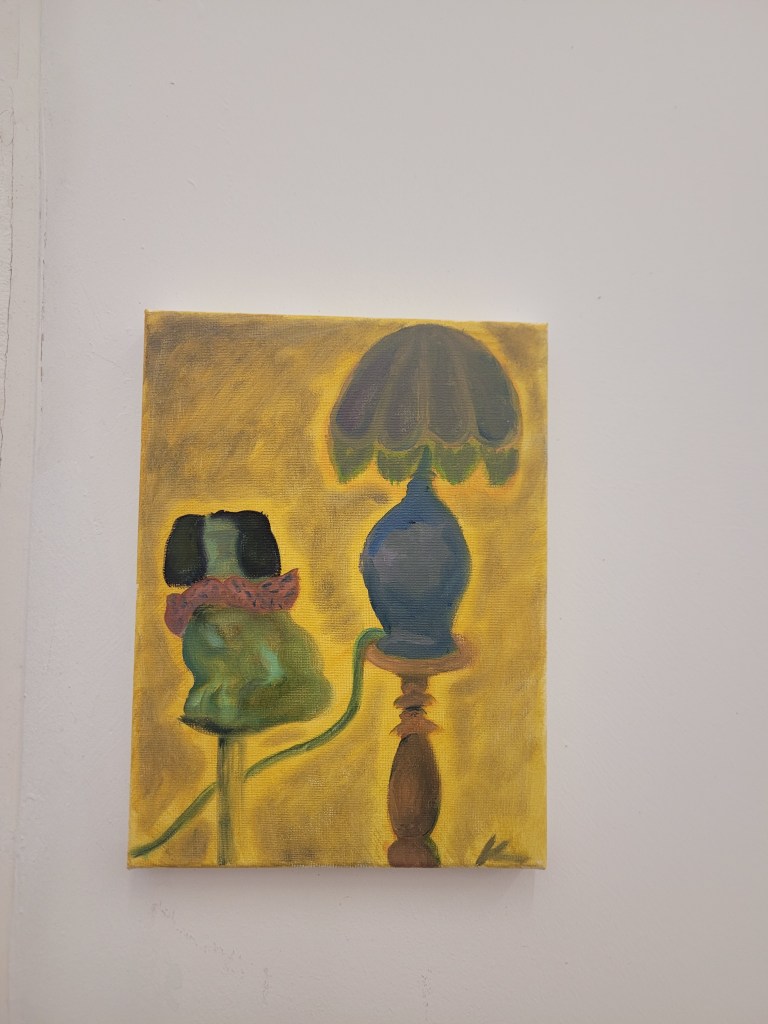
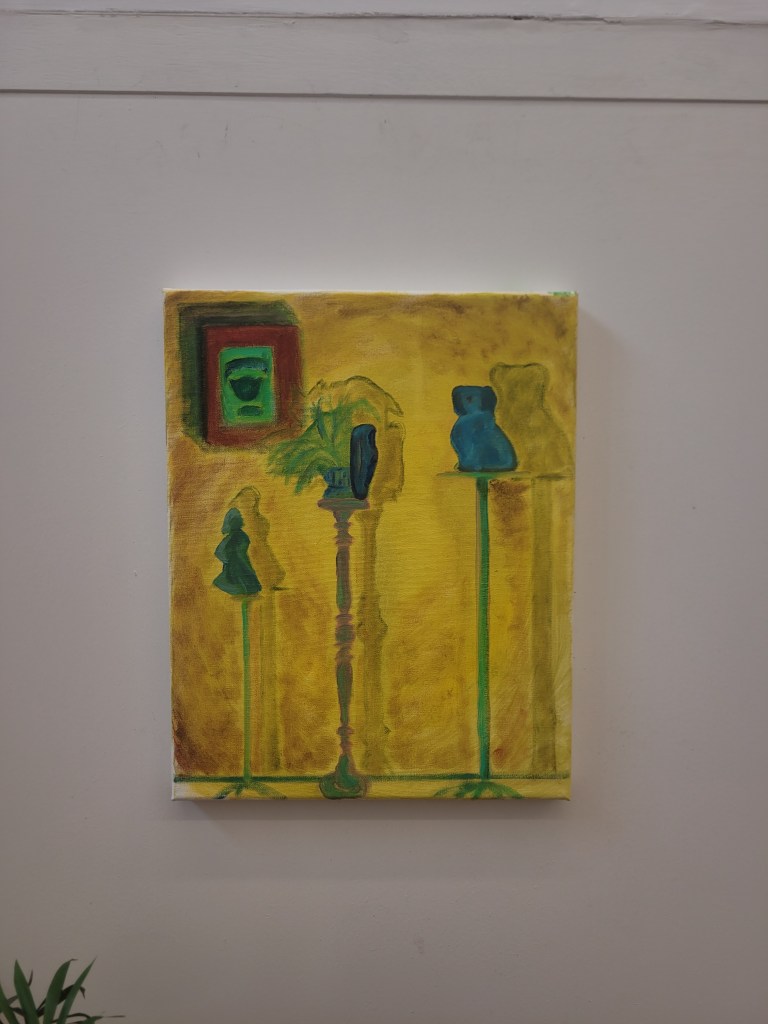
In terms of painting theory or visual theory, I’m using oil painting, used to paint important people and oversell people’s beauty (visa vi royal portraits etc) to paint pigs that I got for like 79p. I’m also not a very natural painter, although I painted in college, like I said I kind of abandoned it in art school and picked it up again later, I’ve never really had any crits about my painting so I can’t really tell if I’m an awful painter or potentially just an awful artist, I have no idea which I feel is unusual for painters as they usually know where they sit on the food-chain and operate accordingly. I like using this medium typically reserved for quite upper class subject matter, to discuss an almost uniquely working class matter, using potentially evil clay pigs as a conduit for that discussion.
So I suppose that’s what I mean, but I’m aware it might only make sense to me. It’s what feels right to do within the work and I just try to follow my nose that way.
– What do you think it says about you as a person, with your decision to take this art style used typically for important people as you said, to paint pigs? Or rather, what do you hope it says about you?
I’m unsure about what it says about me as a person to be honest, I don’t think that’s necessarily any of my business. My work hasn’t ever been about me, even in pieces where I was the subject, I don’t think my work is ever actually about me personally.
Regarding using a medium usually earmarked for the wealthy to portray pigs, I think the metaphor is fairly straight forward: if pigs = police, and police (typically working/lower middle class people) are the protectors of the ruling class/their interests, then portraying them in a medium associated with the ultra wealthy is using an irony, pointing and laughing at an aspirationalism that requires throwing your neighbours under the bus for the interests of the ultra wealthy.
The piece (with the two pigs) is about how women experience sectarianism in Scotland, and how they can be facilitators of it, the mechanism used in this context is the same in many contexts where aspirationalism is concerned: gaining proximity to power at the cost of community, your neighbours, what is morally right, and overall ignoring the fact that you are being as a tool to further the already powerful, and whatever they have promised you in return will likely not materialise. In such instances, the aspirational actors (to use OOO speak) then likely turn on the people around them or more marginalised than them, (people blaming migrants instead of the government for example).
Using oil paint in this way is low key iconoclastic I suppose, I’m preserving those who crave an individual proximity to power in a kind of inverse Dorian Greyish way (maybe?). If they want to act like this and treat people like this, then they will have to make peace with being remembered like that too. And when their prizes don’t materialise, they can look at the oil painting and hopefully realise they were never going to materialise.
Although again, I don’t know what that says about me as a person, and again I don’t think that’s any of my business anyways.
– and to round us off, where is it that you hope this will end? When the light turns off, what would you love to leave behind for other artists, for yourself?
I’m not really sure I see an ending or think about an ending, I tend not to think about the end, more so I mostly think about change or development or morphology, I don’t think anything really ever ends, it just bleeds into another thing.
I would like to leave behind a body of work people can take from and eat from, I know I do that with other artist like Paula Rego, Beryl Cook, Joan Eardley, Alistair Gray, Fergusson, Cadell, Gillies, I don’t imagine that I will leave behind the feasts that they have but I hope I can leave a pla-piece amount at least.
Generally, I would like to make the work I would have loved to have seen as a child, which I have so anything from here is a bonus. My goal is also to start a paper trail of work regarding women and sectarianism, which I have also started to chip away at.
Unfortunately, I do think that once I’m dead, the world won’t be my business anymore and, while I can try my hardest to make it better while I’m here, when I’m gone, I’m gone. We just need to have faith that we have helped people around ourselves enough so that they will be okay.
Join the Newsletter
Connect with Katie
To follow Katie, you can find social media profiles here:
Socials
Instagram
Read other articles in the issue
- Colour, Change, and Rae’s Creative Survival
- Drawn to the Story; Marta rediscovers the artist
- Ghost Stories in Ink and how Sophie is a medium
- The Literal Art of Becoming Whole with Ellie Rose
- There is meaning in the reusable, Cazoshay sees that
- What the Hands Remember, K is hoping for connection
- Wonderment: Enchanted light with Crystal
 ManicWorld Magazine