A Pursuit of Calm with Timothy McGaw
‘Sometimes it’s the feeling of a half remembered dream or a favourite memory or place. These are things that can’t be captured by a camera in the way that they exist in my minds eye. They are a far more complex and abstract than that.‘
– When did you first pick up a brush and why?
Drawing and painting has always been there as a means of relaxation for as long as I care to remember. I’ve always found creativity the shortest route to a state of calmness. Growing up noticed that other kids would be into the things I would draw, so in a sense at that stage I was encouraged by my peers to practice often.
– How has your art style evolved over the years?
I was never overly concerned with realism. I have tremendous respect for artists who can render precise photographic detail. However, my own individual taste for art has always leaned somewhat towards the abstract and the dreamlike. In part, this is because I also enjoy and practice photography, which is a different creative process concerned with creating a more realistic two dimensional representation of a true moment in time.
When I first began to draw at an early age I was influenced by comics and cartoons. I practiced creating my own cartoon characters and stylised worlds for them to occupy. As I got older and my artistic literacy broadened, I became fascinated with more surreal and abstract means of exploring emotions. As a I became familiar with work by the surrealists of the early 20th century I found this to be a big influence on the things I would draw.
– What is your creative process like? What is your thought process before/when creating art?
It can vary wildly depending on my frame of mind or what I’m looking for. Sometimes I will approach the plane with a definite idea of what I see in my mind’s eye. At other times I will simply enjoy the freedom of discovering what the piece wants to be by painting with almost reckless abandon.
-Which of your pieces would you say feels unfinished, if any?
I always find that I force myself to stop. The temptation to continue adding or modifying ideas is never ending. So from that perspective it’s possible to say that each piece is only as finished as the compromise I made with myself at the moment of stopping. But I think that in and of itself adds something to a piece. It ties it to that moment of completion in the mind of the artist.

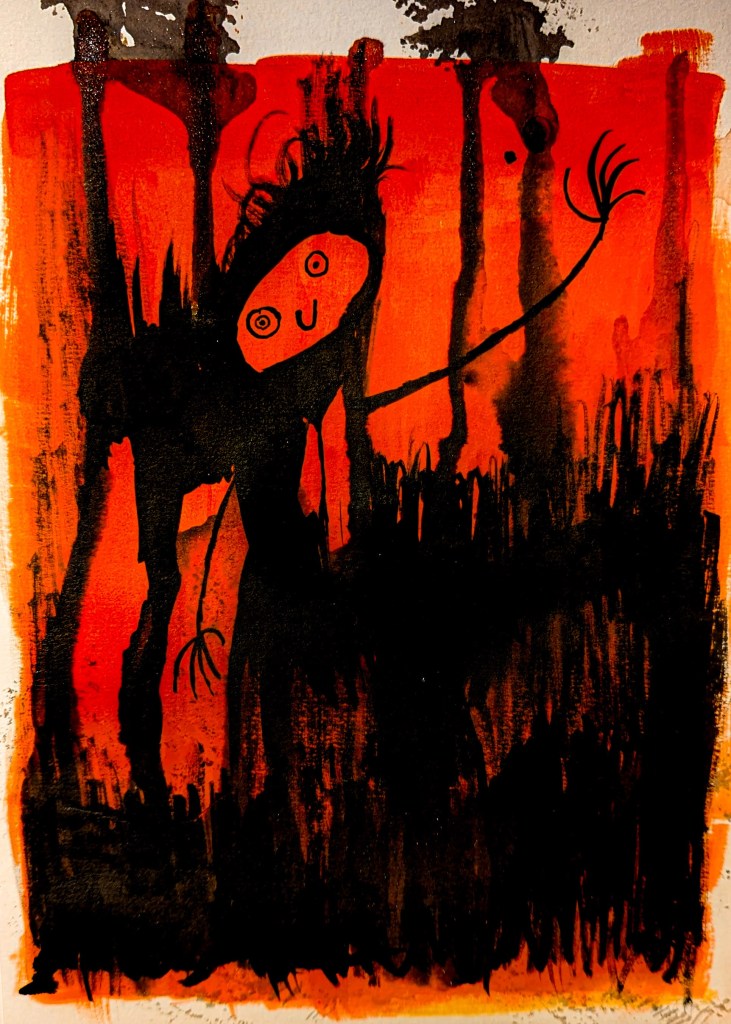
– Where does your inspiration to draw come from?
It’s always a pursuit of calm and introspection. Sometimes it’s the feeling of a half remembered dream or a favourite memory or place. These are things that can’t be captured by a camera in the way that they exist in my minds eye. They are a far more complex and abstract than that.
– You have a unique style, how has it been finding it and do you think you might try another style?
I think my style is always evolving and will continue to do so indefinitely. I draw a lot of inspiration from the work of other artists and I get excited about incorporating the things that I find into my own artistic vocabulary. I’m a big believer in the idea that this is how art evolves. I am not afraid to say that I will put my own spin on something I see and think is fantastic. It’s evolution. This is how new things are created, from the first cave painting to Edward Hopper. So the work will continue to develop and evolve as I add more art and experiences to my vocabulary.
– When creating a piece, do you usually just go with the flow or do you have a finished product in mind?
It varies depending on the moment. Sometimes I have a definite idea. Other times it’s more like I’m just free in the experience of playing and letting the painting reveal itself through the process.
-How did you get into using ink? Are you leaning more towards acrylic?
For a while I was obsessed with inked line art and calligraphy and picked up a cheap pen and some ink. I didn’t really enjoy it too much but I liked the way the ink looked when applied on acrylic. I also picked up a bamboo pen which felt really good to work with. Sometimes I’ll brush the ink onto a piece, for smaller details I’ll use the bamboo. For the finest lines I use a black fine liner. I like working with acrylic because it’s easy to clean up, although the benefits of oil are very appealing to me. I think I’ll try oil when I start making canvases again.
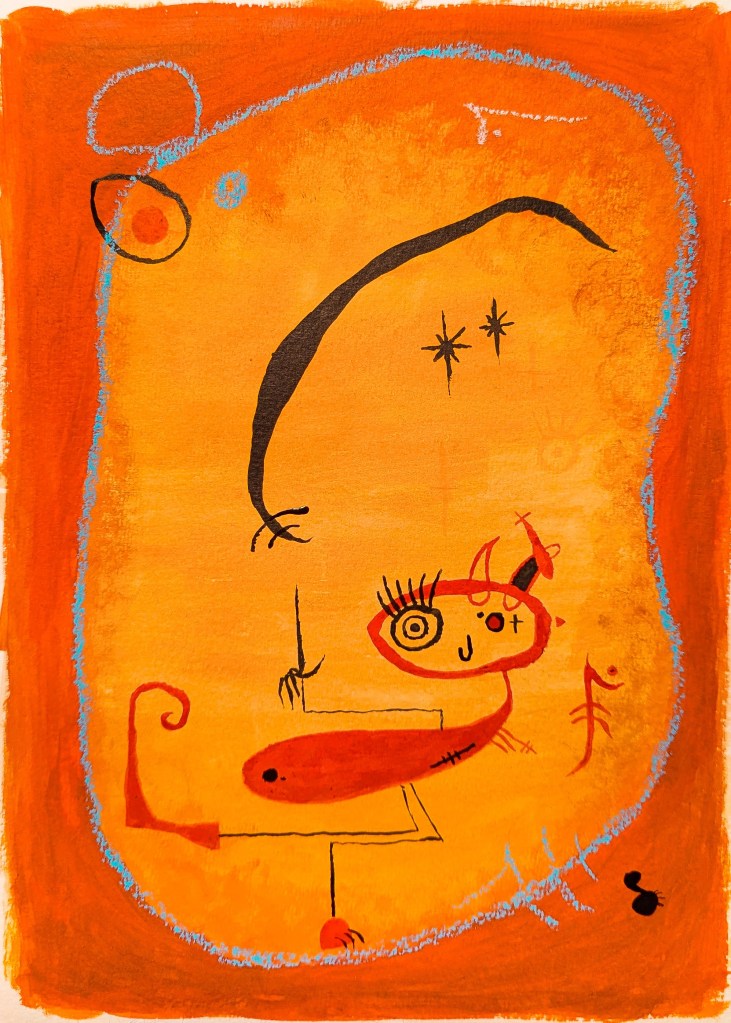


– Your work features a bit of abstract ideas, how are you planning on developing that, if you are.
I think I’ll continue to be drawn towards simple shapes, patterns and symbols. What fascinates me is the way these things are arranged in the frame really dictates the overall feeling for me. I’m very specific about where I place things in order to play with compositional balance or lack of balance depending on the feeling I am trying to represent.
– There is a lot of orange in your work, why do you think that is?
I am drawn to warm, almost red hot colours at the moment. Colour might be one of the effective ways to convey a feeling. I think currently the paintings I am doing feel connected to each other thematically and the colour is a part of that. I anticipate I will get tired of it eventually and explore other feelings.
– Last but not least, what do you think will be the next best thing since sliced bread?
UBI. It’s not right that there’s billionaires and homeless coexisting. Something has clearly gone very wrong here.
Join the Newsletter
Connect with Timothy
To follow Timothy, you can find websites and social media profiles here:
Website
TimothyMcGaw
Socials
Instagram
Read other articles in the issue
- Charlie J: The Art of Nightly Verses and Cosmic Dreams
- Connecting Through Canvas: Teesha’s Artistic Introspection
- Cut and paste: Steve’s perspective
- Cutting Through Moments: My Journey as an Artist
- Frames of Life: The Art of Photography
- Looking through the lens of adventure with Gazzy
- Mitchel X: The Journey of a Musical Soul
 ManicWorld Magazine