Ghosts in Light: The Long Exposure of Memory and Motion
‘I know what I like to shoot & create and I usually have more ideas than time. ‘
– What’s the deal with long exposure? How did you get into it?
My first exposure to the technique was a full page magazine advertisement featuring a shot of a car’s headlights or taillights – I don’t remember which and I can’t recall the product/service being marketed – but it was snaking through a landscape. It might as well have been magic. It seemed clear it was a photograph but I was left in wonder as to how the light trail was created until much later.
Light-painting long-expo – was out taking pictures with my family for Christmas and I had the camera in my hand by my side. In between deliberate shots I was taking photos while walking not realizing it. I captured a happy accident – a set of rooftop lights that seemed to outline the profile of a bird echoed in the colors of the rainbow. It was very simple but it spoke to me. After finding that shot while reviewing photos, I set out to learn how to turn the happy accident into a technique using camera movement & stationary Christmas lights in a dark garage I turned into a studio at night.
Later I began to play with long exposure as a way to create multiple exposures in a single exposure by lens-capping (usually with my hand) and then using some combination of pan/tilt/zoom to overlay scenes – doing the same with the beach photography leads to some neat effects – creating giants next to tiny figures.
– You like blurred photography; why is that so?
I’ve been exploring motion blur or panning photography whenever I can over the last few years. I love the flipped presentation, transferring the sense of motion from the moving object to the static background. It works great with most wheeled vehicles. It gets more difficult to produce great results and freeze the subject if there is any erratic movement but I’ve stumbled into some magically dreamy shots with some subjects that don’t tend to move in a straight line like a surfer carving a wave or skaters. Still much work to do to dial in this technique but it’s a lot of fun working on it and skaters, bikers and others seem happy to oblige when I ask. I’ve met a lot of nice, interesting people pursuing it.
It also shows up in the beach crowd shots where I use just long enough of an exposure to freeze some while others turn into blurry ghosts.
I’m a fan of impressionism and try to mimic that with camera movement, moving subjects or both. Sometimes it works out and sometimes it just a poor out of focus photo with no artistic merit.
– Was there a particular moment or experience that solidified your passion for this art form?
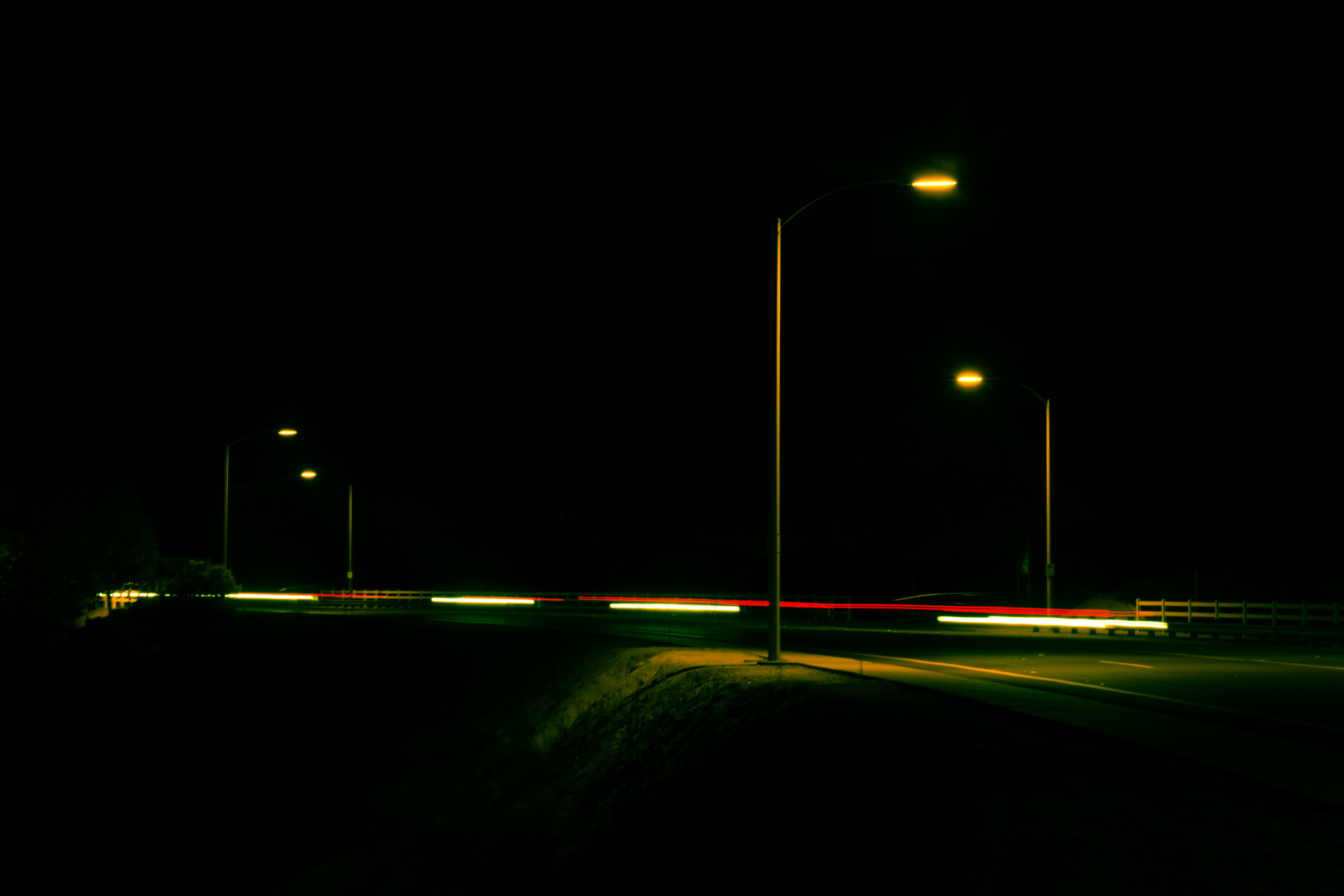
LongExpo? My first good car trails shot in my neighbourhood was very exciting and it was probably the final push over the cliff into a decade of real obsession, squeezing photography into every space I could fit it into, taking my camera everywhere and exploring every idea that came to mind.

What inspires your work and how do you choose the themes you explore?
Artistically, I’m inspired by the color and composition of the following painters: Kandinsky, Van Gogh, Hiro Yamagata, Miro, Chagall, Dali. I love music from nearly all time periods, genres and cultures. Kurt Vonnegut & Tom Robbins are my favourite authors.
I’ve been fortunate that inspiration has rarely been a problem. I know what I like to shoot & create and I usually have more ideas than time. I haven’t yet deconstructed why I make the things I make but I suppose I’ll ponder that when I’m out of ideas.
– How has your approach to photography evolved over time?
I’ve learned a few hard lessons. I’m much better about not getting in my own way by being more organized; I have a lot less free time to indulge in my creative side now so I need to make the time I do count.



I make a ‘pre-flight’ checklist of items I need for any planned shoot, at home or at another location – no more missed opportunities due to forgotten or uncharged batteries, memory cards, warmer clothes to deal with weather changes, etc. Just better planning!
Be ready to shoot upon arrival – if you are going to a location and conditions are setting up right for a great shot, what if the greatest thing that could happen visually IS happening as you arrive and you don’t have batteries loaded or can’t find your memory card. It’s happened to me. And then the magic moment is gone and you can still get some good shots afterwards but the pain of not being ready is tough.
If you feel like you should stop to take a shot, stop and take the shot (when practical and safe). Some of my favourite shots from otherwise underwhelming trips have been following that last impulse on the way out of a location or on a whim, pulling over on the way from where I was shooting to capture something else on the way home.
– Pick a photo from your portfolio that says many things, what’s the story behind it?
No. 344 from my Butterflights series – Butterflies + lights. It’s created via long-exposure light-painting reflection photography – no photoshop or AI trickery. This is hardly the best of the series but it’s symbolic of the creation of this odd concept that seemingly appeared in my life out of nowhere. I didn’t create it with that in mind – that occurred to e afterwards. I just had the idea of a butterfly having just taken flight out of a set of outstretched arms/hands.
I had been looking for a subject I could shoot any time of day, independent of the quality of the light and realized it would have to be something indoors. I found it in this series but didn’t realize it initially. I was in the back yard one night after a rain, looking to take advantage of light painting over the patio puddles to capture a reflection of what I was making. I tried a few random ideas out but the scale of what I was creating was too large to be captured in its entirety in the puddles so I grabbed some tiny finger lights to try something smaller. I tried a few things and then it occurred to me butterflies were the perfect subject. If I light-painted from the puddle up, I could let the reflection create the other half of the butterfly. I love theme and variation, musically and artistically. Given their natural beauty & symmetry and the stunning variety of their wing shapes, colors and markings, I realized this was a subject I could explore at depth without tiring of it quickly. It became a very deep rabbit hole. Because the puddles were uneven, on the next occasion I tried using a mirror instead for better results but soon realized a patio table with a glass table top was perfect. I moved it into the garage, masked up the window and door with some black king size bedsheets and created a mini studio where I could make them at any time allowing me to progress quicker than I could with any outdoor series that might be impacted by light/weather or any other conditions. Eventually, I began creating other scenes and subjects but this series was the genesis of it all and I’ve had a lot of fun exploring it.
– What is the most bizarre way that you were inspired?
I was loading the washer with my daughter and she asked “What does it look like inside when the clothes are washing?” We have a top-loading washing machine with a glass top so we grabbed two flashlights, hit start and looked inside. It was informative for her but visually underwhelming for both of us…and then I realised we could see it differently through my camera via some longer exposures. I learned quickly I had to use cold water cycles because the warm water steamed up the glass top. Soon I had a ridiculous routine and was asking to do all the laundry as it turned into a series. I began to use multiple flashlights through coloured cellophane filters I made with cardboard. It was a fun rabbit hole but I could only do so much with circles in the end. And then I relalised the agitation cycle was just as interesting. Rinse and repeat.
– How do you see the role of photographers evolving in the future?
My crystal ball is cloudy on this one. Photography as an art seems alive and well based on what I see from the photography networks I’m part of online. The depth and breadth of what’s out there is amazing and I know I’m only seeing a fraction of it. I’m sure there are others more finely tuned to answer this, especially those who support themselves through their camera work. I do wonder more and more lately if the only real authentic human artists in the future will be painters, sculptors, potters, or musicians who play acoustic instruments – people who make things with their hands unaided by electric power or generative tech of any kind. Advancements in tech have certainly been a boon to artists in many ways. Modern tools have democratised the creation of art and music or at least lowered the barrier for entry for so many and that is bound to help in the discovery of all kinds of new art and artists. But I have great concerns about AI’s impact on the arts, especially photography and music, and for those who make their living in those industries.
– Last but not least, what is your most effective way of getting out of a creative slump?
Have another passion, I’m blessed to have two artistic pursuits to bounce between with music & photography. Each is a great break from the other and when things are working well, I love to try and combine them.
Be a participant in life. Many artists I know have hyperfocus which allows them to drill deep into whatever they are pursuing and sustain it for very long periods…but It’s easy after a while to hit diminishing returns. If all I do is create for too long, I find I often don’t have anything to say visually or musically. It’s the reaction to and participation in the external world that provides the fuel for my creations.
Long walks without electronic distractions…you need time to marinate and be alone with your thoughts, take in your surroundings.
I also believe in going through the motions. Sometimes you do need a break. But sometimes you need the struggle, you need to push through.. The best way I’ve heard this put as it relates to songwriting is sometimes your have to write 20 bad songs to write one good song…and if you don’t write the 20 bad ones, you won’t get the one good one…It’s quantity equals quality, over time. and I’ve found find your yield/output gets better over time with all of the practice. 2 great songs/5 bad ones….rinse and repeat. You are turning a battleship. It’s incremental progress that is tough to see at any given inspection point but you have to trust its happening as long as you are putting in the work.
 ManicWorld Magazine