A Dream of Time and Lawrence Crane
‘At the very least, if I can believe the purpose and the reasoning behind every aspect I can place that belief into the painting allowing a far more authentic work as opposed to superficial.‘
– Five years in the making, where did the initial idea originate?
‘A Dream of Time’ has in some way through its style or composition or palette always been a piece of work that has been in my mind. The flowing forms of dancers, the colours found within nature used to present forms that are other worldly was the aesthetic that I’ve found myself drawn too. For the past 10 years I have been following the techniques of the Old Masters in order to lift a painting up beyond an image and achieve something that, at the very least, I can apply my own personal narrative too. I had the style of the piece in mind for years, however the meaning behind it evaded me and so it sat in the back of my mind whilst other paintings, drawings and training continued to further articulate my visual language. Six years ago (2019) I started a journey of therapy. Anxiety, depression, a lack of who I was and too much fear or dread was something which I wanted to resolve. Between 2019 and 2024 I followed week after week an unpacking and reframing of my experiences. It was during a titanic shift within my world view and context that in February of 2020 a frozen image popped into my head whilst I was walking and listening to music in which I instantly knew the meaning behind it. I had the narrative and the purpose to the style which I wanted to follow. Once I had the sketch and concept within my mind I then had to work backwards and start to discover the answer of ‘why?’ to what each part of the image meant.
– Why do you think this project took so long?
There were many aspects to this project which I wasn’t aware would extend it’s creation time. I always knew that it would be a piece that would evolve and adapt with how I saw it, but part of the process was the discovery and world building. A part of the creative process was to write, in a narrative format, the series of events that take us to the final image and during this process I had to uncover logical reasons for the events such as: why is the landscape the way it is? Who is the figure that this story revolves around? Who are they interacting with? What does this lead to? In tandem to my own therapeutic journey the story itself grew and expanded from a singular story to a three part series and it was in Part 1 ‘A Dream of Time’ that I would introduce the viewer to this world. This meant that now it wasn’t a singular painting, but a series of paintings which help to describe the characters within the story. But importantly, they had a logic to me that made sense within the context of the story.
Another large part of the extended creation was the techniques behind the painting. Due to its scale, each figure had to be researched and drawn before applied to the canvas. There was play, there were parts to it which were created before being wiped away. There was a back and forth, and this is before the colour studies. I wanted to explore a luminous quality to the light. A glow. And a technique used by the masters to achieve this is ‘glazing’. This technique is a naturally slow technique: a thin layer of paint applied to a previous layer that is dried and with the nature of oil paint, its drying time can be notoriously long. But there was also discovery and experimentation in which each piece had to be documented and tested elsewhere. It would be, more often then not, that there were at least three or four paintings on easels at the same time.
However! After five years of constant painting, countless drawings, 3 different studios and two house moves later I’m so excited to reveal these series of paintings to the world. ‘A Dream of Time’ A Solo exhibition by Lawrence Crane will be exhibited at Elitha’s Fine Art & Collectibles, 1B Holborn Circus, City of London, London EC1N 2HB 5th – 6th April with a Live performance and reading of ‘A Dream of Time’ on Saturday 5th April
– Why is the traveller non-descriptive?
The character which the viewer follows is known as ‘The Traveller’ we follow them through their trials and tribulations. We witness them at their lowest point and their determination against their current circumstance. The Traveller can be anyone, and because of this, I wanted to keep the identity of the Traveller withdrawn to only their purpose: their past and their present. I wanted this to be a character that anyone who reads the story or sees the works can place themselves into. Each painting is in fact a point of view from what the Traveller sees on their journey. If I were to give this character fixed traits this could cast aside others and this is something I did not want to do. A key trait of the Traveller is that they have been traumatised and this is their journey of healing. From my own experience trauma is unbiased, it can be applied to anyone and therefore the Traveller can be anyone. There may be more specifics discovered as the story progresses, but to keep it non-descriptive allows so much more creative freedom which can tie back into the nature of the character.

– How has it been getting all the parts together for an exhibit of this nature?
A show of this nature has required a lot of moving pieces to come together. As the project started out it was slow, and most of the time spent within the context of the project was planning a hypothetical exhibition. However once I had fixed upon this idea of the physical exhibition the parts needed had to be brought together: The music, the sound, the curation of the works all seemed very natural and easy to the concept of the show however I cannot say that it has been a relaxed period! Going into 2025 there were all different aspects needed very quickly, which has put me in contact with other creators. This has been an incredibly exciting time and has really allow the articulation of ‘A Dream of Time’ to reach into areas which are incredibly exciting! But the most important and longest part (Aside from painting it of course!) was the right space. The main painting is large and so needed the right space to breathe in so once the right space was found the rest could come together incredibly quickly.
– Why did you decide to include a written narrative in the project? Is there something about this show that you think deserves context?
Creating a written narrative that was to be included with the collection was never an intentional aspect but rather a part of the creative process. Once I had the image in mind I needed to find the reason to get to that point. At the very least, if I can believe the purpose and the reasoning behind every aspect I can place that belief into the painting allowing a far more authentic work as opposed to superficial. I never formally trained to be a visual artist and painter, my background is rather in Theatre and storytelling. And when I first started out this project, even though I knew it was going to be a series of paintings, that narrative discovery was no different to writing a story. As I started to uncover more of the world and the characters I found very quickly that I could use that forum to workshop my ideas, divulge deeper articulations and could now start to link certain ideas and motifs throughout the paintings. This transformed the way I think of my work. I found myself slowly moving into Visual Storytelling, and this was something that I found incredibly exciting.


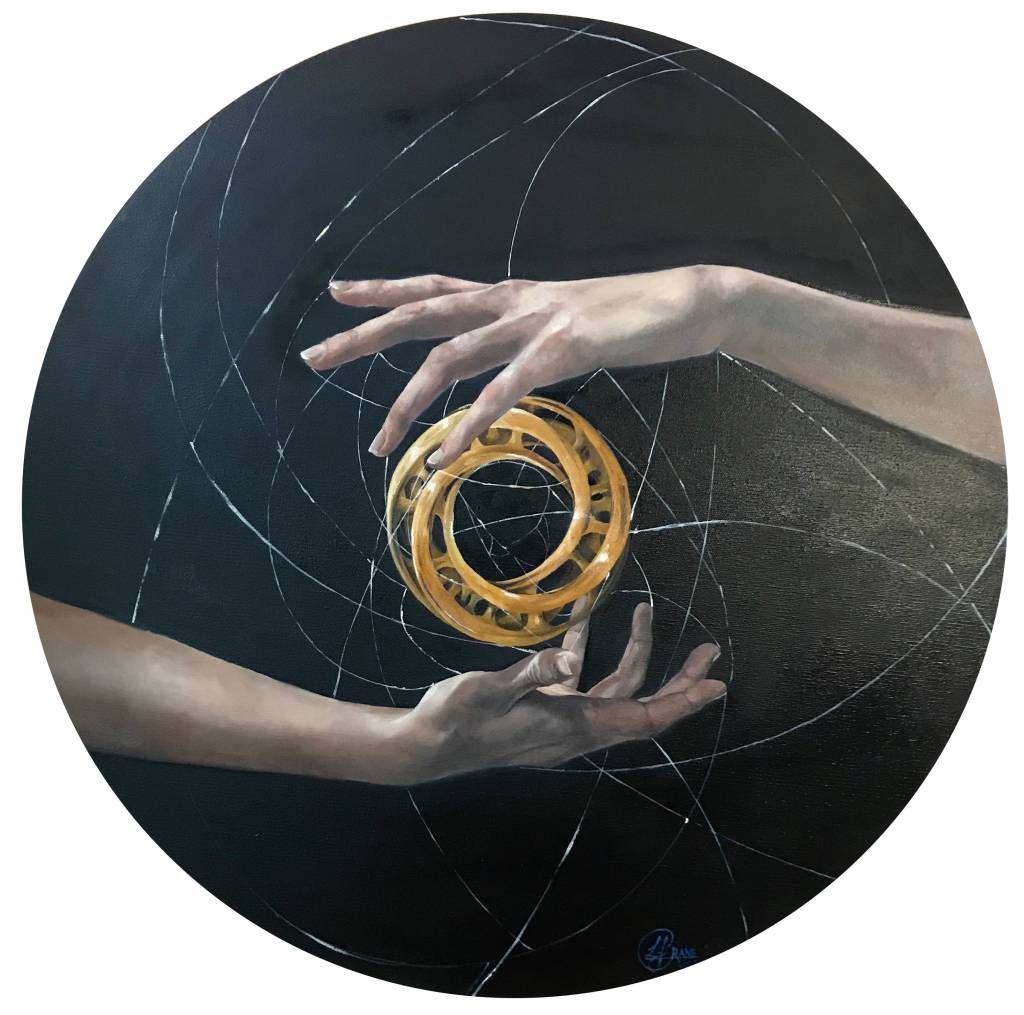
– A lot of your work features time, from what well of time did you draw information for the Connecting Moments series?
Time is something that continues to fascinate me. As we measure our life through the lens of past and future we start to see how and who we are within our present. Memory and imagination are so powerfully linked to how we see ourself that to explore this concept through paintings and drawings wasn’t a conscious choice but rather an unconscious one. ‘Connecting Moments’ started development in 2019 and during this time I found myself reconnecting to aspects of myself that could be traced back to my childhood. But they weren’t specific memories or times, but rather fleeting moments.
Throughout the series I explored moments of connectivity that we have with our hands, to others. Family, friends, loved ones… and how these seemingly tiny moments are what we can remember years on. But it wasn’t just looking back, but also being aware of my present. At the time of the series’ creation COVID-19 changed everyone’s reality and the identity of hands connecting took on a very different context. So through the series I wanted to reach into not just the moments of connectivity that I had experienced, but the moments of present connectivity which at the time, seemed farther apart them before.
days
hours minutes seconds
until
A Dream Of Time
– ‘Hands are how we interact with the world that we are surrounded by.’ How did you come about this conclusion and how did you get to work on expressing that thought in the series?
Hands can be used for many things, they create, hold, nurture, but they can also take, dismantle and break what we have around us. Hands can lift those around us, or pull them down. Hands are the response of action, and action is what we choose or not choose to do. How many times do we use our hands to demonstrate a point or cover something we wish to hide? It were these questions that I pondered as I began sketching out the first ideas of the series and I chose the goodness that hands do to shape the world around us, not through large overarching moments, but those almost forgotten moments where you reach a hand out to a friend. You hold a loved one close. Maybe the hands of an infant hold onto the thumb of a guardian for the first time. These moments are unto themself, so my focus wasn’t upon the portrait of the person, but the portrait of their actions shown through their hands.
– Can you describe a piece that felt like a warm hug to you during tough times?
There have been so many pieces which feel like a warm hug, like home. Florence and the entirety of it’s sculptures, frescos and paintings have always been there to welcome me back whenever I needed it, be it rest or research and inspiration. But to pick a singular work it would be in fact a drawing. The Virgin and Child with St Anne and St John the Baptist by Da Vinci. I’m lucky enough that living in London I am able to visit this piece at my leisure. The deep rich shadows, the softness in the rendering. The delicate nature of the figures in the drawing, how they interact, it is a marvel which I can keep finding more and more in, and sometimes I’ve found as opposed to dissecting the composition, the values, the portraits, sometimes it’s just a pleasure to look, see and to get lost within it’s world.
– Where is the most unconventional place that you have gotten inspiration from? What was the result of that?
Inspiration is something that I’ve found that has to be cultivated but can impact you on a Tuesday afternoon when you’re making a coffee! Music has always been a huge motivator for the images I imagine and create, but sometimes where I’ve found it, it has been walking home from teaching. As an adult tutor and teacher I’m constantly in contact with students who are brand new to the Art world and the questions they ask are ones that have me wandering as I pack up and leave for home (Or the studio!). I usually take a longer journey back, making sure to walk a few stops more than what I would usually need. I usually finish in the evening, and London can be a quieter time. It’s in this walking, with a little music in my headphones that I can allow certain questions, ideas to be mulled over in the back of my mind.
-Last but not least, what colour is the number ‘7’ to you? Please justify your answer.
I love questions like this! 7 for me is a calm number, it’s a sweeping number and one that I imagine to take on a Payne’s Gray hue. There are colder blues and purple greys, the colours that you may find in a mid winter Sunrise. There are some aspects of gold in there, but for me is the gentle palette of the morning.
Join the Newsletter
Connect with Lawrence
To follow Lawrence, you can find social media profiles here:
Socials
Instagram
Website
A Dream of Time
Read other articles in the issue
- Art Beyond Limits: A Journey Through Wood, Texture, and Mike
- Collective Sounds: CHANDNI’s Path in Alternative R&B
- Harmony of Lenses: How Music Shapes Jade’s work
- On the Fast Track: Good Time Locomotive is Blending Genres
- Peeling Back the Layers: Kate’s Creative Process
- Ungrounded and Illuminated: The Artistic Visions of Ezana Girma
 ManicWorld Magazine